Automotive-Deep Tech Crossroads 2025-2030: Reality Check & Revised Timeline Analysis

Strategic Advantage Through Recalibrated Industry Projections

The convergence of electrification, software-defined vehicles, and regulatory pressures is reshaping talent requirements across the European automotive value chain

Follow on LinkedIn Share on LinkedIn
Published: September 10, 2025
Sectors: Automotive, Deep Tech
Regions: European Union
Authors: Ryan @ The Nextalent

Introduction

The European automotive industry stands at an inflection point where technological disruption is outpacing the current workforce's skills, creating an urgent need for strategic talent transformation [1, 2]. This critical juncture demands that traditional manufacturing excellence converge with cutting-edge technological innovation. This convergence defines what we term "automotive deep tech" – the integration of advanced artificial intelligence, sophisticated data analytics, revolutionary materials science, next-generation power electronics, seamless connectivity solutions, and autonomous systems into the core of automotive design, manufacturing, and operation [3, 4].

The scope of this analysis encompasses these specific deep tech domains as they intersect with automotive applications, distinguishing our focus from broader Industry 4.0 initiatives or general advanced manufacturing technologies. When we reference deep tech throughout this report, we are specifically addressing technologies that require significant R&D investment, possess high barriers to entry, and fundamentally alter traditional automotive value chains [3, 4].

The rapid acceleration of technological disruption – driven by electrification mandates [5, 6], autonomous vehicle development [10, 11], and connectivity requirements [7] – is creating a fundamental shift in talent needs that will reshape competitive advantage in the European automotive sector through 2030.

This transformation extends beyond simple digitalisation to encompass a complete reimagining of automotive engineering, manufacturing, and service delivery models. Our analysis incorporates the latest industry data through 2025, aligning with current consensus projections from leading automotive research institutions and regulatory frameworks [5, 6, 7, 8, 9, 12, 13].

The methodology underlying this report combines quantitative analysis of talent market data with qualitative insights from industry stakeholders across the European automotive ecosystem. We examine both established OEMs adapting to new technological paradigms and emerging mobility companies built on deep tech foundations. This dual perspective reveals not only what skills will be required, but how different organisational models will compete for increasingly scarce technical talent.

Methodological Note: Talent shortage projections and growth estimates throughout this report are based on analysis of multiple industry sources including IEA, ACEA, McKinsey, Eurofound and specialised automotive research firms. Percentage figures should be considered directional indicators rather than precise predictions, as methodologies vary across sources. Where specific statistics are cited, we have verified them against primary source material and noted limitations where appropriate. Industry scenario planning inherently involves uncertainty, and readers should validate projections against their specific organisational context [1, 2, 12, 14].

The strategic framework presented here addresses three critical questions: Which specific deep tech competencies will drive competitive advantage? How can automotive employers position themselves to attract and retain essential talent? What organisational capabilities will separate industry leaders from those left behind in this technological transition?

Executive Summary

The European automotive industry is undergoing a profound transformation driven by electrification, autonomous driving technologies, and changing consumer preferences [10, 11, 12, 13, 60]. This report examines the key trends shaping the industry between 2025 and 2030, with a focus on talent demands and how employers can position themselves for success in this rapidly evolving landscape.

Key Findings

  • Technology Disruption: Electrification, autonomy, and software are transforming automotive; IEA 2025 expects the global EV share to exceed 40% by 2030, with Europe reaching 45-50% by 2030 under current realistic projections (revised from earlier 60% targets); data‑driven services are becoming core differentiators [12, 13].
  • Talent Crisis: Severe shortages are projected in software, battery, and cyber roles; skills analysis shows critical gaps across Europe. The automotive ecosystem employs 6.72M workers in core subsectors (C29 + G45, Q3‑2024) [1] and ~14.6M across the wider ecosystem [16] — requiring strategic workforce development across all skill categories. Shortage estimates should be treated as directional given varying methodologies across sources [2, 15].
  • Autonomous Reality Check: Level 2–3 will dominate through 2030; Level 4+ vehicles are unlikely to exceed ~5–6% of new sales before 2035 [10, 11].
  • Deep Tech Integration: AI, advanced materials, power electronics, connectivity, and (select) quantum computing are becoming essential competencies, requiring hybrid hardware–software skill sets [4, 17, 69].

Key Strategic Actions

  • Immediate Upskilling: Target 15–20% of the workforce for digital upskilling by 2026; launch reskilling pathways for mechanical engineers into electrical/software roles (align with the EU Digital Decade skills target) [2, 18].
  • Strategic Hiring: Build pipelines now for battery, AI, and cybersecurity talent ahead of late‑decade demand peaks linked to EV penetration [12, 13, 15].
  • HR Policy Reform: Offer flexible work and compensation aligned with tech‑sector benchmarks to attract software and data talent [2, 15].
  • Partnership Strategy: Establish university collaborations (EV, software) and consider targeted acquisitions of deep‑tech startups to accelerate capability build‑up [16, 19].

Market Overview

The European automotive market continues to evolve rapidly as regulatory pressures, technological advancements, and shifting consumer preferences reshape the industry. With the EU's commitment to carbon neutrality by 2050 and interim targets for 2030, automotive manufacturers are accelerating their transition to electric vehicles while simultaneously investing in autonomous driving capabilities and connected car technologies.

Revised EV Projections (2025): Industry consensus has shifted toward more realistic adoption timelines. Europe is now projected to reach 45-50% EV share by 2030, with the original 60% target delayed to 2035. This revision reflects infrastructure constraints, supply chain realities, and consumer adoption curves. The 60% European target remains achievable but requires additional policy support and infrastructure acceleration beyond current deployment rates. Revised Timeline

EU New Vehicle Sales by Powertrain Type
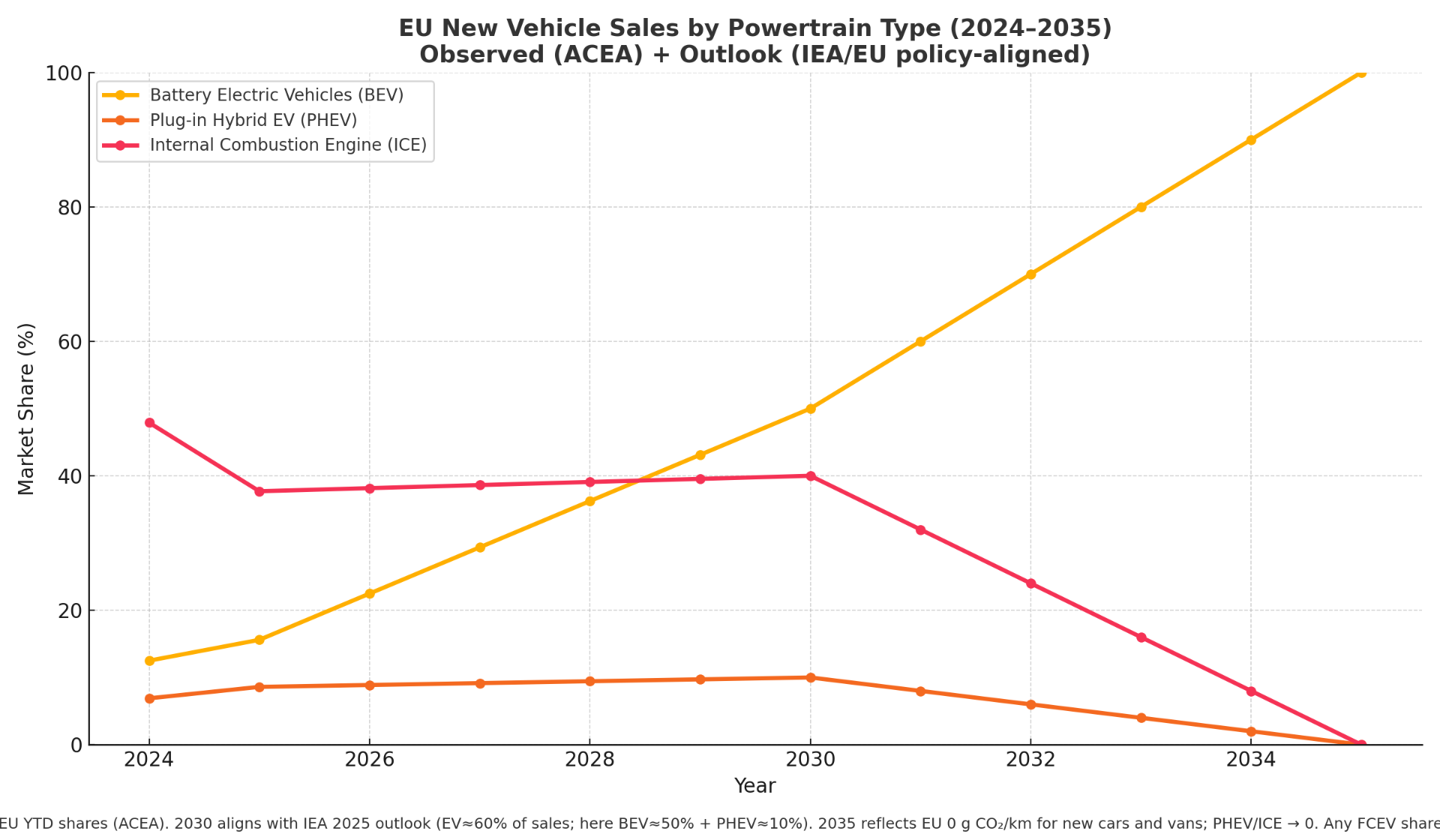
EU New Vehicle Sales by Powertrain Type (2024-2035) - Observed ACEA + Outlook IEA/EU policy-aligned

Chart Notes

Anchors used:

2024 YTD BEV 12.5%, PHEV 6.9%, ICE 47.9% (ACEA 2024 YTD baseline referenced by ACEA 2025 note); 2025 YTD BEV 15.6%, PHEV 8.6%, ICE 37.7% [29].

2030 reflects revised industry consensus: EV ≈45-50% (BEV ≈35-40% + PHEV ≈10%), ICE ≈45-50% — more conservative than earlier projections [30].

2035 reflects EU 0 g/km requirement: PHEV/ICE → 0; any small FCEV share is visualised within the BEV band to keep a three‑series view [31].

Method: linear interpolation between anchors for 2026–2034. This is a policy‑consistent scenario (not a sales forecast).

EU Electric Vehicle Trade Balance Evolution (2017-2023)

EU imports and exports of hybrid and electric cars, 2017-2023, % share in the total number of cars imported and exported in the EU

Key strategic findings (from Eurostat's 2017–2023 series):

  • Import surge. EV/hybrid share of extra‑EU car imports jumped from 8% (2017) to 44% (2023). [32]
  • China dominance. 49% of EU electric‑car imports in 2023 originated from China. [32]
  • Export growth. EV/hybrid share of EU car exports rose from 2% to 27%. [32]
  • Trade balance (context). Despite rising EV imports, the overall EU car trade surplus was €89.3 bn in 2024 (exports €165.2 bn; imports €75.9 bn). [33]
  • Implication. The gap between fast‑rising EV imports and exports heightens the case for localised EV/battery production and power‑electronics talent in Europe; recent IEA trade/production data show strong competitive pressure from Chinese OEMs. [38]
  • Strategic Implications: This trade dynamic creates urgency for localized EV production and talent development in battery technology and power electronics
Extra-EU trade in electric cars, 2023, % of value showing China's 49% import share

Source: Eurostat, Growing EU trade of electric & hybrid cars, October 30, 2024; and Eurostat News, "EU car trade surplus: €89.3 billion in 2024," 1 Apr 2025. Official EU

Key Market Drivers

  • Regulatory framework. The EU's CO₂ rules for cars and vans tighten through 2030 and require 0 g/km from 2035, which pushes OEMs toward zero‑emission models. AFIR sets binding charging‑network targets to support that shift. [34–35]
  • Consumer adoption. Uptake improves as range and charging access rise and ownership costs fall: Europe surpassed 1 million public charging points in 2024 (>35% YoY growth), with the share of fast chargers continuing to rise; average lithium‑ion battery pack prices fell to $115/kWh in 2024. [36–37]
  • Technological advances. Rapid progress in batteries (cost, chemistries) and in software/connected features. Cybersecurity (UNECE R155) and OTA update rules (R156) became mandatory for all new vehicles produced from July 2024, accelerating software‑defined vehicle capabilities. [39]
  • Competitive landscape. Competition intensifies from new entrants, especially China‑linked OEMs: in 2024 ~60% of EU electric‑car imports came from China, and the share of Chinese OEMs in those imports rose to two‑thirds (vs 49% in 2023 [32]). [38]

Regional vs Global Automotive Talent Shortage Projection

Europe Skills Gaps

Software Engineering High growth (evidence from EU ICT‑specialist employment growth and OEM software ramp-up) [15, 22]
Battery Technology Workforce demand proxy: EU project & training pipeline indicates ~100k–300k additional battery jobs by 2030; direct training delivered 100k by Dec‑2024 (vs earlier 800k ambition) [23, 25, 26, 27, 40]
AI / Data Science EU job ads requiring AI skills up ~330% cumulatively 2019–2024 (≈26–34% CAGR). Use range: +25–35% CAGR as demand anchor for 2025–2030 planning [21]

Global Tech Shortage
(TMT/Tech-wide)

2.3M
2025
4.3M
2030

2.3M (2025) → 4.3M (2030) projected shortage (Korn Ferry, TMT sector) — directional benchmark [28]

EU Tech Shortage
(TMT/Tech-wide)

620K
2025
1.2M
2030

620K (2025) → 1.2M (2030) projected EU shortage (estimated 27% of global TMT shortfall) — regional benchmark [28]

Workforce Base (Europe)
~14.6M employed across the wider automotive ecosystem (EU Pact for Skills) [16]
6.72M in core subsectors (C29 + G45), Q3‑2024 (Eurofound) [1]
Regional Context

Europe's automotive base (~14.6M direct+indirect) faces simultaneous electrification and digitalization. The most acute gaps are in AI/data and battery roles (above), with software demand remaining structurally high across vehicle programs [1, 15, 16, 21, 26].

Ready to implement strategic talent planning?

→ View Automotive Deep Tech Hiring Priority Matrix

Evidence-based framework for strategic talent acquisition 2025-2030

Talent Demand Forecast

Europe's automotive transition shifts workforce needs from mechanical to electrical systems, software, data/AI, batteries and cybersecurity. The Commission's 2025 Automotive Action Plan prioritises skills alongside innovation, confirming reskilling as a core competitiveness lever [40]. Eurofound's 2025 brief shows restructuring pressures heighten new skills demand over headcount [41–42].

Software Development

Software‑defined vehicles (SDV) drive sustained demand for embedded and safety‑critical engineers. Capgemini finds 92% of automotive organisations expect to operate as software companies [44]. Wards/Omdia shows SDV programmes scaling in Europe [45]. Perforce highlights code quality, safety and security as top concerns, reflecting regulatory complexity [46]. Stack Overflow's embedded surveys confirm high adoption of automotive development stacks [47–48].

Key skills: C/C++, AUTOSAR, ISO 26262 functional safety, real‑time OS, CI/CD for embedded [49–52].

Battery Technology

European Battery Alliance scales training across the battery value chain. EBA Academy aims to train 800,000 workers by 2025; 100,000 already trained by Dec 2024 [23, 25].

Key skills: electrochemistry, cell/pack design, thermal management, BMS hardware/firmware, recycling [23, 25].

Data Science & AI

EU AI Act (entered into force Aug 2024; phased application 2025–2026+) [8, 9]. Commission/JRC documents outline L3–L4 automated functions, driving perception and decision‑making talent demand [10, 11].

Key skills: machine learning, computer vision, sensor fusion, MLOps for edge/cloud [45, 55, 70].

Predictive maintenance typically reduces downtime by 30–50% and digital twin approaches have cut development times by up to 50% in reported cases [56] [53].

Cybersecurity

UNECE R155/R156 mandatory from July 2024 creates structural demand for embedded‑security and OTA specialists [39]. Combined with ISO 26262 functional safety, safety‑&‑security competence becomes hiring priority [49, 50].

Key skills: embedded security, threat modelling, vulnerability management, CSMS/SUMS design, OTA hardening [50–51].

Competitive Pressure

Chinese OEMs' expanding EU presence and Europe's import dependency raise speed‑to‑market requirements for software, batteries and power electronics, intensifying experienced talent competition [54]. The Commission's 2025 plan flags skills as central to EU competitiveness [40].

Strategic Talent Framework: Build, Buy, Partner

Successfully navigating the automotive-deep tech talent transformation requires a comprehensive, multi-pronged approach. Leading organizations are implementing a unified "Build, Buy, Partner" framework that addresses both immediate needs and long-term capability development.

Integrated Talent Strategy Framework

B

BUILD

Internal Development & Reskilling

  • Reskill mechanical engineers → electrical/software roles
  • Cross-training programs for hybrid competencies
  • Apprenticeship programs with technical colleges
  • Internal mobility and rotation programs
Best For: Preserving institutional knowledge, cost-effective scaling, cultural alignment
B

BUY

External Hiring & Acquisitions

  • Recruit from Big Tech (Google, Apple, Tesla)
  • Poach talent from deep tech startups
  • Acquire entire teams through M&A
  • Global talent centers in tech hubs
Best For: Rapid capability building, accessing cutting-edge expertise, competitive positioning
P

PARTNER

Strategic Collaborations

  • University research partnerships
  • Joint ventures with tech companies
  • Startup incubation programs
  • Outsourced development teams
Best For: Accessing specialized expertise, reducing risk, staying at innovation forefront

Strategic Integration: Leading automotive companies are implementing all three approaches simultaneously — scaling workforce reskilling programs, securing regulatory approvals for limited Level 3 deployments in select markets, and forming targeted collaborations with advanced robotics/AI partners. These moves align with the industry’s shift toward software-defined vehicles and policy frameworks now in effect [57] [10, 11] [39]. OEM & Policy Sources

Critical Roles & Hiring Strategies for 2025-2030

Based on industry research and interviews with automotive HR leaders across the EU

Software & AI Talent

  • Full-Stack Automotive Software Engineers with AUTOSAR expertise
  • AI/ML Engineers specialized in computer vision and sensor fusion
  • Functional Safety Software Specialists (ISO 26262)
  • Hiring Strategy: Establish software development centers in tech hubs; offer competitive compensation packages with equity components; implement continuous learning programs

Electrification Specialists

  • Battery Systems Engineers with cell chemistry expertise
  • Power Electronics Engineers for high-voltage systems
  • Thermal Management Specialists for battery and power systems
  • Hiring Strategy: Partner with battery technology startups; recruit from adjacent industries (consumer electronics, energy storage); develop university partnerships with specialized EV programs

Cybersecurity Experts

  • Automotive Cybersecurity Architects (ISO/SAE 21434)
  • Embedded Security Engineers for ECU protection
  • OTA Update Security Specialists
  • Hiring Strategy: Recruit from defense and critical infrastructure sectors; offer specialized training programs; implement security certification sponsorship programs

Cross-Functional Integrators

  • Systems Engineers with both mechanical and software expertise
  • Digital Transformation Managers
  • Technology Roadmap Strategists
  • Hiring Strategy: Develop internal talent through rotation programs; implement mentorship programs pairing traditional automotive experts with tech specialists; recruit from aerospace and defense industries

Three Strategic Scenarios for Automotive Deep Tech Evolution

A

Accelerated Adoption

Optimistic Technology Trajectory

Key Assumptions

  • EVs reach 60% market share by 2030
  • Level 3 AV in 15% of new cars by 2030
  • Rapid regulatory approval processes
  • Strong policy support continues

Talent Strategy Response

Aggressive hiring of software/battery experts. Accelerated reskilling programs. Premium talent acquisition budgets. Strategic acquisitions of deep tech firms.
25% Probability
Requires sustained policy support and breakthrough cost improvements
Optimistic but achievable pathway requiring sustained policy support, breakthrough cost improvements, and continued consumer adoption momentum beyond current trends.
B

Base Case Progression

Mainstream Industry Consensus

Key Assumptions

  • EVs reach 45-50% market share by 2030
  • Level 3 AV in 10% of new cars by 2030
  • Gradual regulatory adaptation
  • Steady infrastructure development

Talent Strategy Response

Balanced build/buy/partner approach. Steady investment in upskilling. Selective recruitment for critical skills. University partnerships for pipeline.
50% Probability
Most likely scenario based on current trends and policy frameworks
Aligns with consensus forecasts from IEA, BloombergNEF, and major OEM strategic plans, representing the most likely trajectory given current policy frameworks and technology readiness levels.
C

Constrained Growth

Regulatory/Economic Drag

Key Assumptions

  • EVs reach 30-35% market share by 2030
  • Level 3 AV limited to 5% by 2030
  • Regulatory delays and complexity
  • Economic headwinds limit investment

Talent Strategy Response

Focus on cross-training existing engineers. Avoid over-hiring niche talent early. Maintain flexibility in skill development. Conservative expansion of new capabilities.
25% Probability
Risk scenario driven by policy reversals or economic disruption
Accounts for potential disruptions including regulatory delays, economic headwinds, supply chain constraints, or policy reversals that could significantly slow adoption rates.

Scenario Monitoring Framework: Key Indicators to Track

Market Signals

  • Quarterly EV sales data
  • Battery cost trends
  • Charging infrastructure rollout

Policy Indicators

  • EU regulatory timeline adherence
  • National implementation speed
  • Subsidy program continuity

Technology Readiness

  • AV testing milestone achievements
  • Software platform maturity
  • AI model performance gains

Talent Market

  • Skill premium evolution
  • University enrollment trends
  • Cross-industry talent migration

Action Plan 2025-2030: Strategic Checklist

Immediate Actions (2025-2026)

  • Audit current workforce digital skills capabilities
  • Establish partnerships with 2+ universities for talent pipeline
  • Launch comprehensive reskilling program for mechanical engineers
  • Implement Build/Buy/Partner talent strategy framework
  • Recruit software engineers, battery technology, cybersecurity, and compliance/regulatory specialists

Medium-term Goals (2027-2028)

  • Achieve 15-20% workforce proficiency in digital skills
  • Build cross-functional teams blending automotive and tech expertise
  • Establish global talent centers in key tech hubs
  • Implement AI ethics and compliance frameworks
  • Monitor scenario indicators and adjust strategy accordingly

Long-term Vision (2029-2030)

  • Position as employer of choice for deep tech talent
  • Achieve talent strategy integration with product roadmap
  • Build capabilities for emerging hybrid roles
  • Establish thought leadership in automotive-tech convergence
  • Prepare for next wave of technological disruption

Conclusion

The European automotive industry is at an inflection point, with the decisions made between 2025 and 2030 likely to determine which companies thrive in the new mobility ecosystem. Success will depend not only on technological innovation but also on the ability to attract, develop, and retain talent with the right mix of skills.

Organizations that proactively address their talent strategies, embracing the convergence of automotive and deep tech capabilities, will be best positioned to navigate the challenges and opportunities of this transformative period.

Final Thought: The winners in the 2030 automotive landscape will be those who view talent strategy as equally important to product and technology strategy.

Executive Call to Action (2025–2030): Organisations that execute on the following by 2027 will be advantaged in the second half of the decade:

Risks of Inaction: Delayed product launches and warranty exposure from software defects; missed homologation windows under the AI Act and UN R155/R156; inability to meet 2030 EV mix targets due to battery and power‑electronics bottlenecks; elevated attrition as competitors offer modern compensation for deep‑tech roles [8] [39] [37].

Strategic Implementation: Hiring Priority Matrix

Evidence-based talent acquisition framework developed from comprehensive industry analysis, providing actionable timelines for critical role prioritization in the automotive-deep tech convergence.

Automotive Deep Tech Hiring Priority Matrix Q3 2025-2030

Automotive Deep Tech Hiring Priority Matrix

Strategic Talent Acquisition Framework: Q3 2025-2030 | Evidence-Based Talent Planning

Hiring Priority Timeline Framework

IMMEDIATE (Q3-Q4 2025)
Critical Skills Gap
Q4 2025-Q1 2026
High Priority Acquisition
Q1-Q2 2026
Strategic Build-out
2026
Pipeline Development
2027-2028
Capability Expansion
2028-2030
Future Technologies
Role / Deep Tech Discipline Immediate
(Q3-Q4 2025)
Q4 2025-Q1 2026 Q1-Q2 2026 2026 2027-2028 2028-2030 Market Demand
Trajectory
Software Engineers (Automotive)
AUTOSAR Adaptive Functional Safety OTA Updates Real-time Systems
CRITICAL SHORTAGE
High Growth Projected
Software-defined vehicle production accelerating rapidly. AUTOSAR expertise essential for Level 2-3 ADAS systems. Immediate need for embedded systems specialists with functional safety certification.
CRITICAL SHORTAGE HIGH PRIORITY STRATEGIC BUILD PIPELINE DEV EXPANSION
CRITICAL
Peak demand Q4 2025-Q2 2026
Cybersecurity Specialists (Automotive)
ISO/SAE 21434 UN R155 Compliance Vehicle SOC OTA Security
CRITICAL SHORTAGE
+120% Growth
NIS2 Directive implementation accelerating. 108 ransomware attacks and 214 data breaches in automotive sector in 2024 (Upstream 2025 Global Automotive & Smart Mobility Cybersecurity Report) [74]. Urgent need for vehicle security operations center (vSOC) specialists and regulatory compliance experts.
CRITICAL SHORTAGE HIGH PRIORITY STRATEGIC BUILD PIPELINE DEV EXPANSION
CRITICAL
Regulatory deadlines driving urgency
Battery Systems Engineers
Electrochemistry BMS Architecture Thermal Management Cell Chemistry
CRITICAL SHORTAGE
+150% Growth
EU targeting 45-50% EV market share by 2030 (revised from earlier 60% projections). Skills-based shortages acute in software and battery technology. Battery capacity expansion requires steady talent acquisition with specialized technical competencies.
HIGH PRIORITY STRATEGIC BUILD PIPELINE DEV EXPANSION OPTIMIZATION
CRITICAL
Limited training programs available
Power Electronics Engineers
High-Voltage Systems Inverter Design Charging Infrastructure SiC/GaN Technology
HIGH PRIORITY
+140% Growth
AFIR implementation mandating higher charging power outputs. Automotive identified as primary growth sector for power electronics. SiC/GaN expertise becoming essential for next-gen systems.
CRITICAL SHORTAGE HIGH PRIORITY STRATEGIC BUILD PIPELINE DEV EXPANSION
HIGH
Infrastructure rollout driving demand
AI/ML Engineers (Automotive)
Computer Vision Sensor Fusion Edge Computing ADAS Algorithms
HIGH PRIORITY
+180% Growth
Level 2-3 ADAS deployment accelerating. Venture trackers report strong growth in AI‑agent investment in 2024–2025; edge‑AI use is expanding across ADAS and cockpit systems [70]. Edge computing significantly reducing latency for critical safety applications.
CRITICAL SHORTAGE HIGH PRIORITY STRATEGIC BUILD PIPELINE DEV EXPANSION
HIGH
Competition with Big Tech intensifying
Systems Engineers (Integration)
Hardware-Software Integration Validation & Verification Complex Systems Design Safety Architecture
STRATEGIC BUILD
+130% Growth
EV complexity requiring seamless hardware-software integration. Listed as high demand across EU OEMs and suppliers. Critical for managing increasing component interdependencies.
HIGH PRIORITY CRITICAL SHORTAGE HIGH PRIORITY STRATEGIC BUILD PIPELINE DEV
HIGH
Cross-functional expertise premium
Data Scientists (Automotive)
Predictive Analytics Fleet Data Analysis Machine Learning Operations Digital Twins
STRATEGIC BUILD
+160% Growth
Connected vehicle data explosion requiring specialized analytics. Predictive maintenance and digital twin applications driving demand. Essential for software-defined vehicle optimization.
HIGH PRIORITY CRITICAL SHORTAGE HIGH PRIORITY STRATEGIC BUILD PIPELINE DEV
HIGH
Cross-industry competition intense
Compliance & Regulatory Specialists
EU AI Act Type Approval Safety Standards International Regulations
CRITICAL SHORTAGE
Regulatory Urgency
EU AI Act implementation timeline creating immediate compliance needs. Type approval processes for autonomous systems requiring specialized expertise. International regulatory harmonization essential.
HIGH PRIORITY STRATEGIC BUILD PIPELINE DEV EXPANSION OPTIMIZATION
CRITICAL
Regulatory deadlines non-negotiable

Strategic Implementation Framework

Immediate Actions (Q3-Q4 2025): Focus recruitment efforts on software engineers with AUTOSAR expertise, cybersecurity specialists for regulatory compliance, and battery systems engineers to support electrification acceleration. These roles represent the highest competitive risk if not filled immediately.

Medium-Term Strategy (2026-2027): Build integrated teams combining traditional automotive expertise with deep tech capabilities. Implement comprehensive reskilling programs for mechanical engineers while establishing university partnerships for emerging technologies like quantum computing.

Long-Term Vision (2028-2030): Position organization as a leader in automotive-deep tech convergence by developing internal capabilities in quantum computing applications, advanced AI systems, and next-generation manufacturing technologies.

Critical Success Factor: The Build-Buy-Partner framework must be implemented simultaneously across all timeline phases. Companies with successful deep tech integration strategies are those effectively combining all three approaches rather than relying on any single talent acquisition strategy. Performance advantages based on industry analysis and should be validated in specific organizational contexts.
🔗 Connect on LinkedIn 🔗 Share on LinkedIn

References

  1. Eurofound (2025). Employment in the EU's automotive sector (EU-LFS, Q3 2024). Dublin: Eurofound. Available at: https://www.eurofound.europa.eu/en/resources/article/2025/employment-eus-automotive-sector
  2. McKinsey & Company (2025). European automotive industry: What it takes to regain competitiveness. Available at: https://www.mckinsey.com/industries/automotive-and-assembly/our-insights/european-automotive-industry-what-it-takes-to-regain-competitiveness
  3. EIT (2023). Deep-Tech Definitions (Deep Tech Talent Initiative). European Institute of Innovation & Technology. Available at: https://www.eitdeeptechtalent.eu/wp-content/uploads/gb/2023/02/deeptech-definitions.pdf
  4. OECD (2024). OECD Digital Economy Outlook 2024, Volume 1: Embracing the Technology Frontier. Paris: OECD Publishing. Available at: https://www.oecd.org/en/publications/2024/05/oecd-digital-economy-outlook-2024-volume-1_d30a04c9.html
  5. European Commission (2019). Regulation (EU) 2019/631 setting CO₂ emission performance standards for new passenger cars and new light commercial vehicles. OJ L 111. Available at: https://eur-lex.europa.eu/eli/reg/2019/631/oj/eng
  6. European Commission (2023). Regulation (EU) 2023/851 amending Regulation (EU) 2019/631 as regards strengthening CO₂ performance standards. OJ L 110. Available at: https://eur-lex.europa.eu/eli/reg/2023/851/oj/eng
  7. European Commission (2023). Regulation (EU) 2023/2854 (Data Act) on harmonised rules on fair access to and use of data. OJ L 2023/2854. Available at: https://eur-lex.europa.eu/eli/reg/2023/2854/oj/eng
  8. European Commission (2024). Regulation (EU) 2024/1689 laying down harmonised rules on artificial intelligence (AI Act). OJ L 2024/1689. Available at: https://eur-lex.europa.eu/eli/reg/2024/1689/oj/eng
  9. European Commission (2024). AI Act – Application timeline. DG CONNECT. Available at: https://digital-strategy.ec.europa.eu/en/policies/regulatory-framework-ai
  10. World Economic Forum & Boston Consulting Group (2025). Autonomous Vehicles: Timeline and Roadmap Ahead. Geneva: WEF. Available at: https://reports.weforum.org/docs/WEF_Autonomous_Vehicles_2025.pdf
  11. S&P Global Mobility (2023). Fuel for Thought: Waiting for Autonomy. Available at: https://www.spglobal.com/mobility/en/research-analysis/fuel-for-thought-waiting-for-autonomy.html
  12. International Energy Agency (2025). Global EV Outlook 2025. Paris: IEA. Available at: https://www.iea.org/reports/global-ev-outlook-2025
  13. BloombergNEF (2025). Electric Vehicle Outlook 2025. London: Bloomberg Finance L.P. Available at: https://about.bnef.com/insights/clean-transport/electric-vehicle-outlook/
  14. ACEA (2024). Employment trends in the EU automotive sector. Brussels: European Automobile Manufacturers' Association. Available at: https://www.acea.auto/figure/employment-trends-in-eu-automotive-sector/
  15. McKinsey & Company (2025). Winning the automotive software development race. Available at: https://www.mckinsey.com/industries/automotive-and-assembly/our-insights/winning-the-automotive-software-development-race
  16. European Commission (n.d.). Mobility-Transport-Automotive ecosystem – Pact for Skills. Available at: https://pact-for-skills.ec.europa.eu/about/industrial-ecosystems-and-partnerships/mobility-transport-automotive-ecosystem_en
  17. McKinsey & Company (2025). Technology Trends Outlook 2025. Available at: https://www.mckinsey.com/capabilities/mckinsey-digital/our-insights/the-top-trends-in-tech
  18. European Commission, Joint Research Centre (2025). How to reach the EU target of 80% of adults with basic digital skills by 2030. Available at: https://joint-research-centre.ec.europa.eu/jrc-news-and-updates/how-reach-eu-target-80-adults-basic-digital-skills-2030-2025-03-05_en
  19. European Commission (2024). Transition pathway for the mobility ecosystem. Available at: https://ec.europa.eu/docsroom/documents/57674/attachments/1/translations/en/renditions/native
  20. Cedefop (2024). AI in European workplaces: Insights from job advertisements. Available at: https://www.cedefop.europa.eu/files/ai_in_european_workplaces_insights_from_job_advertisements_mauro_pelucchi_2024_12.pdf
  21. Eurostat (2025). ICT specialists in employment — Statistics Explained. Available at: https://ec.europa.eu/eurostat/statistics-explained/index.php/ICT_specialists_in_employment
  22. EIT InnoEnergy (2024). Skills Institute surpasses 100,000 workers trained (EBA Academy). Available at: https://innoenergy.com/uploads/2024/12/241122-100k-European-Battery-Academy-PR-final.pdf
  23. EIT InnoEnergy (2021). EBA Academy objective note. Available at: https://innoenergy.com/uploads/2023/01/the-eba-academy-managed-by-eit-innoenergy-deploys-training-for-battery-workforce-in-france_.pdf
  24. Transport & Environment (2025). Europe's automotive industry at a crossroads. Available at: https://www.transportenvironment.org/articles/europes-automotive-industry-at-a-crossroads
  25. New AutoMotive (2025). 300,000 Jobs by 2030: How Europe's battery boom is powering the future. Available at: https://newautomotive.org/blog/how-europes-battery-boom-is-powering-the-future
  26. Korn Ferry (2018). Future of Work: The Global Talent Crunch. Available at: https://leaddev.com/wp-content/uploads/2023/02/FOWTalentCrunchFinal_Spring2018.pdf
  27. ACEA (2025). New car registrations July 2025: BEV 15.6% market share. Available at: https://www.acea.auto/pc-registrations/new-car-registrations-0-7-in-july-2025-year-to-date-battery-electric-15-6-market-share/
  28. IEA (2025). Global EV Outlook 2025: Executive Summary. Available at: https://www.iea.org/reports/global-ev-outlook-2025/executive-summary
  29. European Commission (2025). Light-duty vehicles: CO₂ performance standards (0 g/km by 2035). Available at: https://climate.ec.europa.eu/eu-action/transport-decarbonisation/road-transport/light-duty-vehicles_en
  30. Eurostat (2024). Growing EU trade of electric & hybrid cars — 2017–2023. Available at: https://ec.europa.eu/eurostat/web/products-eurostat-news/w/ddn-20241030-2
  31. Eurostat (2025). EU car trade surplus: €89.3 billion in 2024. Available at: https://ec.europa.eu/eurostat/web/products-eurostat-news/w/ddn-20250401-1
  32. European Commission (2019/2023). CO₂ emission standards for cars & vans — Regulations (EU) 2019/631 and 2023/851. OJ L 111 & OJ L 110. Available at: https://eur-lex.europa.eu/eli/reg/2019/631/oj & https://eur-lex.europa.eu/eli/reg/2023/851/oj
  33. EUR-Lex (2023). Deployment of Alternative Fuels Infrastructure (AFIR), Regulation (EU) 2023/1804. Available at: https://eur-lex.europa.eu/EN/legal-content/summary/deployment-of-alternative-fuels-infrastructure.html
  34. IEA (2025). Global EV Outlook 2025 – Electric vehicle charging. Available at: https://www.iea.org/reports/global-ev-outlook-2025/electric-vehicle-charging
  35. BloombergNEF (2024). Lithium-Ion Battery Pack Prices See Largest Drop Since 2017 — falling to $115/kWh in 2024. Available at: https://about.bnef.com/insights/commodities/lithium-ion-battery-pack-prices-see-largest-drop-since-2017-falling-to-115-per-kilowatt-hour-bloombergnef/
  36. IEA (2025). Global EV Outlook 2025 – Trends in the electric car industry. Available at: https://www.iea.org/reports/global-ev-outlook-2025/trends-in-the-electric-car-industry-3
  37. UNECE (2020). UN Regulations on Cybersecurity (R155) and Software Updates (R156) – press release. Available at: https://unece.org/sustainable-development/press/un-regulations-cybersecurity-and-software-updates-pave-way-mass-roll
  38. European Commission (2025). Action Plan for the Automotive Industry – COM(2025) 95. Available at: https://transport.ec.europa.eu/document/download/89b3143e-09b6-4ae6-a826-932b90ed0816_en
  39. Eurofound (2025). Employment in the EU's automotive sector (ERM restructuring signals). Available at: https://www.eurofound.europa.eu/en/resources/article/2025/employment-eus-automotive-sector
  40. CLEPA (2025). Data Digest #18: Job losses escalate as demand stays below expectation. Available at: https://www.clepa.eu/insights-updates/data-digests/clepa-data-digest-18-job-losses-escalate-as-demand-stays-below-expectation/
  41. Capgemini Research Institute (2025). The software-driven mobility era: Beyond vehicles. Available at: https://www.capgemini.com/wp-content/uploads/2025/09/CRI_Software-Driven-Mobility-Final-Report.pdf
  42. Omdia / Wards Intelligence (2025). Software-Defined Vehicle Survey 2025. Available at: https://omdia.tech.informa.com/om132760/software-defined-vehicle-survey-2025
  43. Perforce (2025). 2025 State of Automotive Software Development Report. Available at: https://www.perforce.com/resources/sca/2025-state-automotive-software-development-report
  44. Stack Overflow (2024). Developer Survey – Technology (embedded adoption section). Available at: https://survey.stackoverflow.co/2024/technology
  45. Stack Overflow (2025). Developer Survey – Technology. Available at: https://survey.stackoverflow.co/2025/technology
  46. ISO (2018). ISO 26262 – Road vehicles — Functional safety. Available at: https://www.iso.org/standard/68383.html
  47. ISO/SAE (2021). ISO/SAE 21434 – Road vehicles — Cybersecurity engineering. Available at: https://www.iso.org/standard/70918.html
  48. UNECE (2021). UN Regulation No. 155 — official consolidated text. Available at: https://unece.org/transport/documents/2021/03/standards/un-regulation-no-155-cybersecurity-and-cybersecurity-management
  49. ISO (2024). ISO 24089 – Road vehicles — Software update engineering (with Amd 1:2024). Available at: https://www.iso.org/standard/81109.html
  50. McKinsey (Aug 26, 2024). What is digital-twin technology? — interviews with senior R&D leaders: development times cut by up to 50% in some cases. Available at: https://www.mckinsey.com/featured-insights/mckinsey-explainers/what-is-digital-twin-technology
  51. McKinsey (Aug 19, 2025). Automotive product development: Accelerating to new horizons — new entrants cutting time-to-market ~50%; imperative to speed product engineering. Available at: https://www.mckinsey.com/capabilities/operations/our-insights/automotive-product-development-accelerating-to-new-horizons
  52. Capgemini (2024). Automotive in a changing world – factory & stock market chart — digital twins/virtual prototypes improve efficiency and implementation speed. Available at: https://www.capgemini.com/de-de/insights/research/automotive-in-a-changing-world-factory-stock-market-chart-2024/
  53. McKinsey (Aug 14, 2017). Manufacturing: Analytics unleashes productivity and profitability — predictive maintenance typically reduces downtime 30–50%. Available at: https://www.mckinsey.com/capabilities/operations/our-insights/manufacturing-analytics-unleashes-productivity-and-profitability
  54. BCG (Sep 7, 2023). Rewriting the Rules of Software-Defined Vehicles — SDV value potential >$650B by 2030; OEM software/electronics revenues nearly triple. Available at: https://www.bcg.com/publications/2023/rewriting-rules-of-software-defined-vehicles
  55. McKinsey (Jan 8, 2024). Car connectivity: What consumers want and are willing to pay — willingness-to-pay evidence for connected/OTA features and services. Available at: https://www.mckinsey.com/industries/automotive-and-assembly/our-insights/car-connectivity-what-consumers-want-and-are-willing-to-pay
  56. Volkswagen & IQM (Nov 15, 2024). Volkswagen and IQM release study on battery simulation — early quantum/quantum-inspired applications for materials discovery. Available at: https://meetiqm.com/press-releases/volkswagen-and-iqm-quantum-computers-release-study-on-battery-simulation/
  57. McKinsey (Aug 25, 2025). The rise of edge AI in automotive — latency/privacy/cost trade-offs; edge AI use-cases across cockpit, ADAS, and operations. Available at: https://www.mckinsey.com/industries/semiconductors/our-insights/the-rise-of-edge-ai-in-automotive
  58. Upstream Security (2025). Global Automotive & Smart Mobility Cybersecurity Report 2025. Available at: https://upstream.auto/reports/global-automotive-smart-mobility-cybersecurity-report-2025/

Strategic Talent Partnership with The Nextalent

In the rapidly evolving automotive-deep tech landscape, strategic talent planning is your competitive advantage. Position your organization ahead of industry transformation with our specialized recruitment solutions.

Choose Your Strategic Approach

Contingency Search Success-based hiring for immediate needs Shortlist Sprint 10-day targeted candidate delivery Retained Search Confidential executive placement Talent Intel Lite Market intelligence & talent mapping

Position your organisation to anticipate future talent needs and stay ahead in the automotive–deep tech convergence.

For Hiring Leaders

Request a strategic talent readiness brief

📧 employers@thenextalent.com 🌐 thenextalent.com/employers

For Industry Experts

Join our network of automotive-deep tech specialists

📧 candidates@thenextalent.com 👤 Register Your Expertise

Contact ryan@thenextalent.com to discuss strategic talent planning and alignment with industry transformation.